This post is also available in:
 ไทย
ไทย
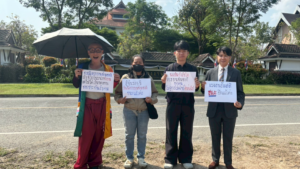
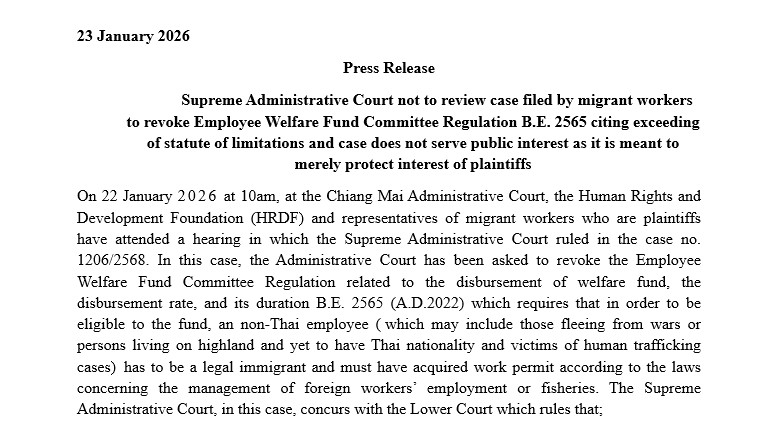
On 22 January 2026 at 10am, at the Chiang Mai Administrative Court, the Human Rights and Development Foundation (HRDF) and representatives of migrant workers who are plaintiffs have attended a hearing in which the Supreme Administrative Court ruled in the case no. 1206/2568. In this case, the Administrative Court has been asked to revoke the Employee Welfare Fund Committee Regulation related to the disbursement of welfare fund, the disbursement rate, and its duration B.E. 2565 (A.D.2022) which requires that in order to be eligible to the fund, an non-Thai employee (which may include those fleeing from wars or persons living on highland and yet to have Thai nationality and victims of human trafficking cases) has to be a legal immigrant and must have acquired work permit according to the laws concerning the management of foreign workers’ employment or fisheries. The Supreme Administrative Court, in this case, concurs with the Lower Court which rules that;
“Since the claimants ask the Administrative Court to revoke the Regulation and such request is deemed to fall under jurisdiction of the Court as it concerns a dispute with an administrative agency or since an authority has allegedly issued an unlawful legislation. Nonetheless, the Supreme Administrative Court deems that the four migrant workers who are claimants in this case have failed to file the case within the 90-day deadline since the day the cause of litigation should be known or should have been known to them when the Regulation was issued and later published in the Government Gazette, or via other means. For a person to be eligible to bring the case, it has to count from the day the Regulation was published in the Government Gazette. It is also deemed by this Court that such case is filed simply to protect individual rights or benefits of only the four petitioners. It is not considered a case filed to protect public interest or personal status. The Court, therefore, decides to not accept to review the case and orders that it be disposed of.”
The case began when the four migrant workers filed a complaint with the labour inspector on 28 June 2022 alleging that they were dismissed by a security services company and were not given due severance pay and not paid their last month’s salary from 1 to 30 September 2021, for altogether 72,800 baht. The labour inspector ordered that the compensation be paid to the four workers. The employer, however, refused to act in its compliance and the employees were unable to have the order executed against their employer since the employer has already moved away their property and shut down the office. As a result, the employees have applied for the employee welfare fund since 26 January 2023.
On 10 July 2023, the Chiang Mai Office of Labour Protection and Welfare issued a letter no. Chor Mor 0030/Wor 3528 and Chor Mor 0030/Wor 3529 dated 4 July 2023 to inform them of the results of their application for the employee welfare fund that the Employee Welfare Fund Committee in its meeting no. 6/2023 on 22 June 2023 decided to not pay them the employee welfare fund deeming their application did not meet the requirements set forth in the Employee Welfare Fund Committee Regulation related to the disbursement of welfare fund, the disbursement rate, and its duration B.E. 2565’s Article 7, second paragraph claiming the employees were non-Thai and worked without permits.
For the four workers, they deem that the Employee Welfare Fund Committee Regulation is a secondary law which has been issued in contradiction to the spirit of the Labour Protection Act B.E. 2541. In principle, the Act aims to protect all employees regardless of their immigration status or legal status as attested to clearly in the definitions prescribed in the Labour Protection Act B.E. 2541’s Section 5. They have therefore filed the case with the Chiang Mai Administrative Court to ask for the rescinding of such Regulation. The case has gone through the procedure until it reached the Supreme Administrative Court and the Supreme Administrative Court ruled to not accept to review the case.
HRDF’s opinions
Even though the Court decided to dismiss the petition, HRDF, however, finds this case has exposed key challenges to access to the Employee Welfare Fund among the migrant workers who have made contribution to our economy. In particular, the legal protection prescribed in the Regulation is contrary to the intent to protect the employees according to the Labour Protection Act B.E. 2541 whose definition of “employee” does not differentiate employees based on their nationalities or immigration statuses.
There has also been a case study of migrant workers who used to be denied access to the Employee Welfare Fund and after their litigation which was fought through to the Supreme Court’s Labour Division which ruled that the 35 migrant workers be given welfare fund for the amount of 939,770 baht. The ruling affirmed labour rights which shall not be barred by their legal statuses citing the Supreme Court’s verdict in Black Case no. Ror 212–246/2564 and Red Case no. Ror 58–92/2565 (please see https://hrdfoundation.org/?p=7634&lang=en ).
Still, law enforcement agencies continue to issue regulations which are incompatible with the statutory laws in order to discriminate against and exclude migrant workers who may lack legal statuses. As a result of which, the migrant workers who are injured parties in this case are barred from accessing the Employee Welfare Fund. Such Regulations will also give a license for certain employers from acting in compliance with the law and continue to exploit the workers while failing to pay them properly and the employees are left with no legal recourse.
Limited leverage of workers to ensure fair employments Workers are usually not able to regulate the acts of their employers or the existing policies concerning the management of migrant workers. As a result, they have to bear the brunt from such lack of compliance. For example, the workers’ work permits have not been renewed even though the workers have already filed the applications and paid the fees via either their employers or brokers arranged by the employers. Or workers are unable to renew their statuses as the work permit renewal policies are incompatible with the documentation procedure in the sending countries as a result of which more than one million workers are not able to renew their work permits within the deadline. This is attested to by the fact that the Ministry of Labour has to propose on a yearly basis for the cabinet to approve the policies to renew labour registration causing many migrant workers to lose their registered statuses or to not have their permits renewed.
Access to labour protection among the vulnerable groups Certain groups of workers are exposed to obstacles that impede their access to state protection when they are in need of help. Such discrimination against migrant workers regarding their access to protection and remedy according to the labour protection law does not only violate the Constitution, the Labour Protection Act and international treaties, but also works unfavorably to the procedure to forge free trade agreements between Thailand and the European Union since it is a requirement of the FTA procedure to include a condition inductive to trade and sustainable development. Such condition includes a standard of labour protection which respects international treaties and the International Labour Conventions which protect all workers without discrimination.
HRDF, therefore, would like to recommend to the government and concerned authorities to;
- Revoke existing regulations and guidelines which may impede full access to labour protection immediately
- Promptly provide remedy to workers affected by such regulations and guidelines
- Explore possibilities to improve the labour protection mechanisms in light of the currently diverse forms of employment to ensure all groups of workers are not left behind and to promote the investment atmosphere based on the business and human rights policies of the state.
For more information please contact
Human Rights and Development Foundation (HRDF)
Email: info@hrdfoundation.org