This post is also available in:
 ไทย
ไทย
Funder: International Labour Organization (ILO)
Duration: 26 August 2024 – 25 August 2026

“Migrant workers are important to the Thai economy. Yet, a number of them are employed in informal sector…making them ineligible to labour law protection and proper social welfare causing an impact to the labour and economic sectors and the nation’s economic stability”
Key issues
- Labour rights violation by employers including being denied overtime pay, unfair dismissal, unpaid sick leave, and verbal pressure.
- Limited access to rights and information, as number of workers are not aware of their basic rights and dare not demand and complain.
- Structural complexity as workers without employers are not able to apply for social security invoking Section 33 and pregnant workers can only afford private health insurance and are not aware/certain about their maternity leave.
Findings
- Problems stemming from employers’ treatment: Testament to how labour rights violation persists.
- Lack of overtime pay: Manufacturing workers are denied formal OT, yet have to take on more work than normal time.
- Employers’ wage discrimination during their medical leave: Certain groups of workers are denied paid sick leave.
- Employers’ verbal pressure and humiliation: Creating psychologically unsafe working environment
- Employers’ unfair dismissal: Employees are denied special severance pay in lieu of advance notice
“All of these reflect…weakness of regulatory mechanisms and the enforcement of labour law in practice.
2. Migrant workers are scantly aware of labour rights and human rights: Despite outreach effort, workers in various areas are found to either lack “understanding” or have “misunderstanding”. Therefore, it is necessary to reach out to them multiple times to ensure local workers understand and are able to effectively apply the knowledge.
- Migrant workers are unaware of social security benefits: Unaware as to how to apply for medical benefit, child delivery, or income compensation.
- Migrant workers eligible for social security benefits, but dare not demand /unaware of complaint mechanism: Lack of regular advice on complaint mechanism and lack of leaders or collective bargaining fearing of losing job, and therefore dare not make demand or fight for their rights.
📌 Workers’ doubts
- Workers without employers: Workers want to know if they are eligible to apply for social security by themselves?
Answer: No, they cannot apply for social security invoking Section 33 since they need to have employers to help pay contributions.
- Lack of social security for female workers during pregnancy: Only have access to private health insurance from employer – Workers not certain about detail of their child delivery benefits?
Answer: Depending on insurance policy, have to inquire employer or insurance company
“The above uncertainty reflects….the need to ensure easy-to-understand information…on a regular basis and being friendly to workers”
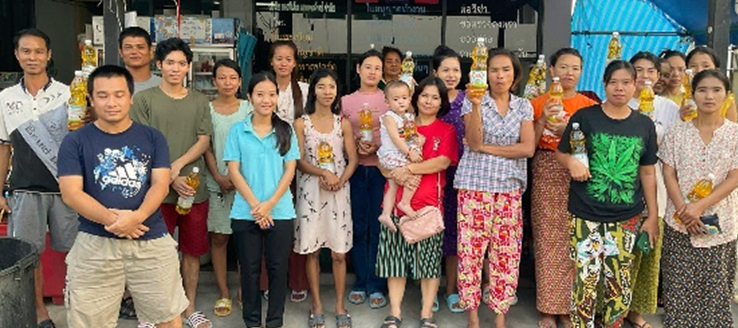
Findings in brief
Key issues found concern employment, leave, lack of knowledge about rights and access to information…On employment…Workers have to take on more work without receiving overtime pay. Some were unfairly dismissed. Pressure was put on them verbally while being denied severance pay…. Issues concerning leave…Workers are denied paid sick leave. …Issues concerning knowledge…Workers misunderstand or not aware of social security benefits and have no way to seek information, which is relevant to…Issues concerning access to information…which is difficult to understand, lacks clarity, and no easy-to-access sources of information in community.
Table: Key issues and findings
| Issues | Findings |
| Employment | Increased workload without overtime pay, unfair dismissal, verbal pressure, denied severance pay |
| Leave benefit | Denied paid sick leave |
| Knowledge | Misunderstand or unaware of social security, their own rights, no way to ask for information |
| Access to info | No easy-to-understand info, no sources of information in community |
Source: Samut Sakhon Chapter, Human Rights and Development Foundation, 2025
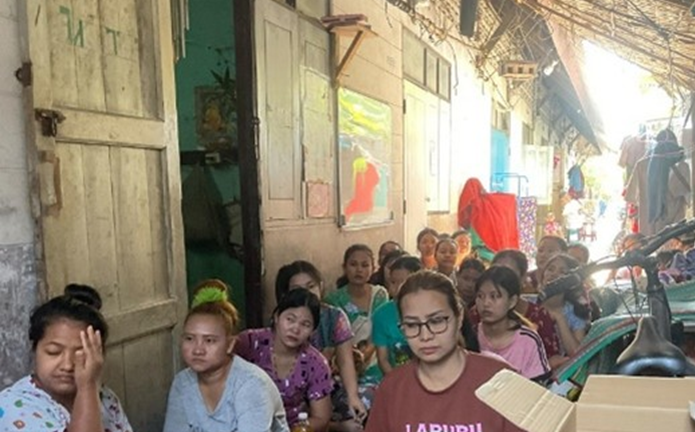
Conclusion from community outreach
Our analysis conforms that….migrant workers continue to face structural problems and lack effective protection… Therefore, cooperation among workers, business and government sectors is key to enhance standards of labour rights and ensure fair economic system.
| Issue | Factor | Description |
| Structural issue analysis | Internal (Workers) | Skill, knowledge, understanding, and ability to conduct collective bargaining of migrant workers |
| External (Economic system and law) | Highly flexible labour market, demand of cheap labour Labour law provides no universal protection leaving out workers Legal enforcement not possible in practice | |
| Impact on various sectors | Workers | Lack of welfare Income insecurity Vulnerable to rights violation |
| Business sector | Small-scale businesses need to rely on informal labour causing insecurity. | |
| Government sector | Overall economy does not reflect reality and fairness impacting stability of labour system and human rights. | |
| Policy recommendations and implementation | Workers | Conduct on-site training/visit to community to raise awareness about social security benefits, labour rights and laws concerning migrant workers and complaint mechanism.Recruit peer educators in each community to raise awareness and to coordinate access to services among workersDevelop media or manuals in different language which are easy to understand to ensure workers are able to review their rights by themselves. |
| Business sector | Promote fair employmentProvide welfare for all groups of workers including their dependents and their families | |
| Government sector | Revise labour law and basic law to apply to informal labour Enhance regulatory mechanisms including HRDD (Human Rights Due Diligence), BHR (Business and Human Rights)Promote roles of labour organizations and civil society |
Source: Samut Sakhon Chapter, Human Rights and Development Foundation, 2025
Issues concerning protection of migrant workers, the case of informal labour – Thailand
From conducting outreach to community and assisting migrant workers to have access to services, labour law, social protection and their own rights, we have found 16 case studies of migrant workers employed in informal sector who have received our assistance from various occupations (manufacturing, construction, fishery, service, agriculture) and found that informal labour widely face employment insecurity, lack labour law protection and basic welfares. Their issues and welfares can be clustered into groups as follows;
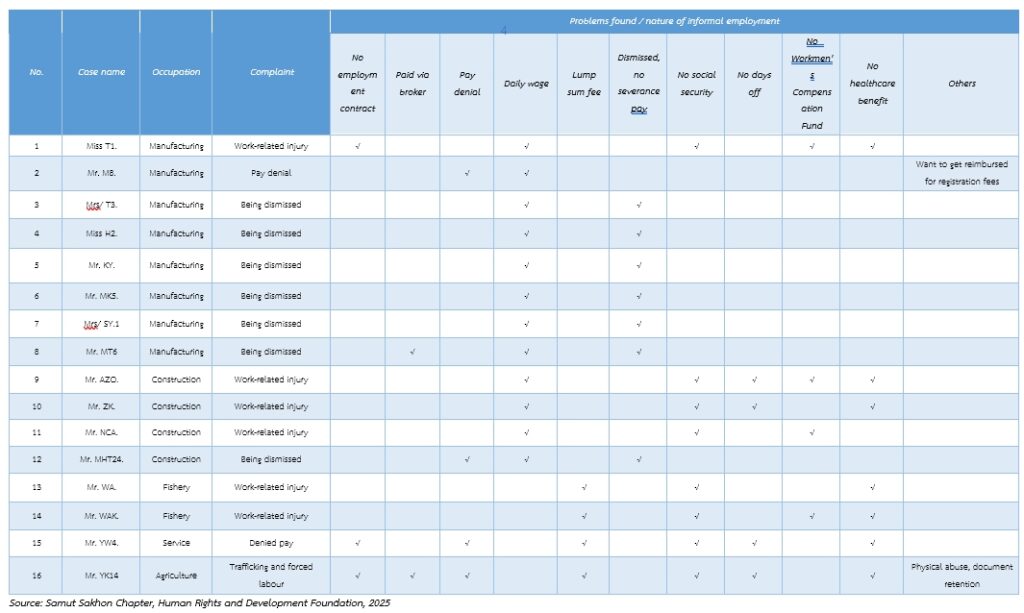
Problems found for migrant workers in informal sector– Thailand, segregated by work
| Work | No. (cases) | Key issues found |
| Manufacturing | 8 | Being dismissed without severance pay, pay denial, no employment contract, no social security, no health insurance, paid via broker |
| Construction | 4 | Work-related injury, daily wage, no social security, no health insurance, no days off |
| Fishery | 2 | Work-related injury, no social security, no health insurance, lump sum fee |
| Service | 1 | no employment contract, pay denial, lump sum fee, no social security, no days off, no health insurance |
| Agriculture | 1 | no employment contract, pay denial, lump sum fee, no social security, no days off, no health insurance, paid via broker (Case of human trafficking and forced labour, physical abuse, travel document retention) |
Source: Samut Sakhon Chapter, Human Rights and Development Foundation, 2025
Key impacts on migrant workers in informal sector– Thailand segregated by issues / nature of employment
| Issues / nature of employment | No. (cases) | Key impacts |
| Daily wage | 12 | Lack of job security and long-term benefits |
| No social security | 8 | Lack of social protection when sick or being dismissed |
| No health insurance | 7 | Impacting health and incurring expense when sick |
| No severance pay after dismissal | 7 | Incompatible with labour law protection |
| Work-related injury | 4 | Disability risk and lack of legal protection |
| No days off | 4 | Lack of basic labour rights |
| Pay denial | 4 | Blatant labour rights violation |
| Lump sum fee | 4 | Lack of right to bargaining and fundamental welfare provided for by law |
| No employment contract/informal employment | 3 | Employment not recognized under labour law |
| Paid via broker | 2 | Lack of employment transparency and evidence for filing claim when denied benefits |
Source: Samut Sakhon Chapter, Human Rights and Development Foundation, 2025
Overall impacts on migrant workers – Case studies of migrant workers in informal sector in Thailand
Labour rights violations: Pay denial, dismissed with no severance pay, no employment contract
Health and safety: Cases of injured workers in construction and fishery sectors are denied compensation or medical expense.
Violent exploitation: Cases of forced labour and human trafficking in agricultural sector including physical abuse and document retention (review of lessons learned separately)
Community Outreach and Legal Access
Contact:
Human Rights and Development Foundation (HRDF)
Address: 87 Soi Sitthichan, Sutthisan Winitchai Road, Sam Sen Nok, Huai Khwang, Bangkok 10310
Phone: 662 277 6882, 662 277 6887 Fax. 02 2776882 ext 108
Email: info@hrdfoundation.org Website: hrdfoundation.org