This post is also available in:
 ไทย
ไทย
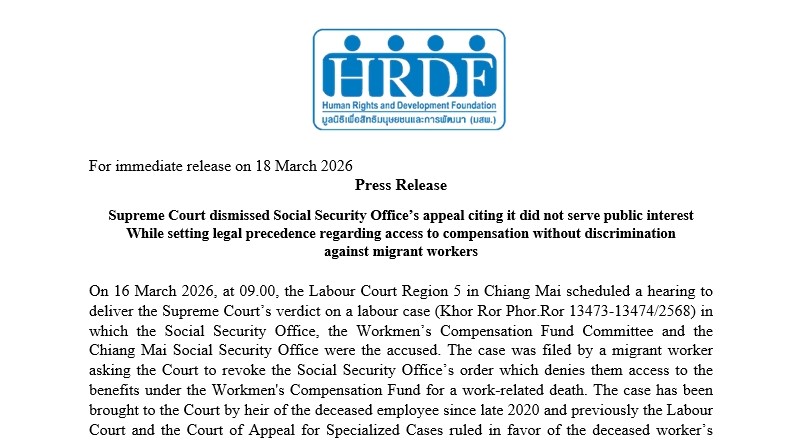
On 16 March 2026, at 09.00, the Labour Court Region 5 in Chiang Mai scheduled a hearing to deliver the Supreme Court’s verdict on a labour case (Khor Ror Phor.Ror 13473-13474/2568) in which the Social Security Office, the Workmen’s Compensation Fund Committee and the Chiang Mai Social Security Office were the accused. The case was filed by a migrant worker asking the Court to revoke the Social Security Office’s order which denies them access to the benefits under the Workmen’s Compensation Fund for a work-related death. The case has been brought to the Court by heir of the deceased employee since late 2020 and previously the Labour Court and the Court of Appeal for Specialized Cases ruled in favor of the deceased worker’s heir. It has prompted the Social Security Office and others to file an appeal motion to the Supreme Court while the deceased worker’s heir has lodged their objection to such application reiterating that denial of access to the benefits under the Workmen’s Compensation Fund is an infringement of the rights of the employee whose death was related to their work.[1]
On the judgment day, the Supreme Court’s Labour Division did not allow the three accused to appeal the decision, dismissed the appeal application and dismissed the application for a stay of the legal excitation of the verdict pending the review of the case against the Social Security Office and others by the Supreme Court. In its dismissal, the Supreme Court held that the three accused’s appeal motion does not constitute a material issue that is worth the Supreme Court’s review[2] since this case is neither concerned with an issue that serves public interest nor public order, and not compatible with the Court of Appeal for Specialized Cases’ verdict which had ruled on important legal issues and there has never been a legal precedence made by the Supreme Court.
As a result, the Court of Appeal for Specialized Cases’ verdict is considered final and the deceased worker’s heir shall have access to the benefits under the Workmen’s Compensation Act B.E. 2537 related to the work-related death.[3]
Aung Jing, wife and the deceased worker’s heir, states that this verdict brings her justice that has long been awaited by her family after more than five years of the litigation. Her husband who was employed as a construction worker passed away in 2020 without receiving any compensation from the Workmen’s Compensation Fund under the Social Security Office’s supervision. Her family has to weather through tremendous suffering, albeit she has received assistance from HRDF in this litigation. She reiterates that all workers should be treated equally and should be entitled to protection immediately since the first day the employee starts to work in compliance with the spirit of the Workmen’s Compensation Act. This can ensure that workers and their families receive the protection and compensation when they face any work-related injury, illness, death or disappearance.
Pasuta Chuenkhachorn, lawyer of this case, states that Thailand has ratified the 1981 International Labour Organization Convention No. 155 for occupational safety and health (OSH) in 2025. As a result, Thailand is obliged to adopt measures to ensure safety, health and welfare of all employees and to develop an effective compensation system for workers facing work-related accidence without discrimination.
Meanwhile, Sumitchai Hattasan, a labour rights lawyer, explains that the verdict in this case complies with the precedence set in the Supreme Court’s Labour Division’s[4] and the Supreme Administrative Court’s verdicts[5] which establishes that a review of the entitlement to the Workmen’s Compensation Fund must be made based on “factual information pertaining to the employer-employee relationship”, regardless of the format of the employment contract. And “should there be actual work done and the pay has been made, the employer-employee relationship shall arise and that should give rise to access to the Workmen’s Compensation Fund immediately as well.”
Such precedence setting case shall ensure the enforcement of law based on the rule of law to protect all workers in Thailand, regardless if they are Thai or migrant workers. Therefore, concerned authorities should adopt such legal precedence and apply it. An effort should be made to ensure understanding among all officials countrywide to genuinely respect labour rights and ensure their access to the Workmen’s Compensation Fund.
The Human Rights and Development Foundation (HRDF) finds that this litigation is not only an attempt to restore justice for the family of the deceased worker. Rather, it sheds light on a lack of access to compensation among the migrant workers as a result of guidelines issued by the Social Security Office including;
- As a result of a lack of understanding in non-discrimination principle, even though Thailand has signed a series of international instruments to combat discrimination, there has always been no effort to heed to the legal precedence and an attempt to revise the revoked guidelines in order for the officials of the Social Security Office and the Workmen’s Compensation Fund Committee to continue discriminate against migrant workers in terms of their compensation. HRDF secures evidence that demonstrates how complaints have been filed by the workers who have been denied access to the Workmen’s Compensation Fund including workers who died during the collapse of the State Audit Office of the Kingdom of Thailand’s buildings when an earthquake happened in 2025. As the SSO officials still gave priority to verifying the employer-employee relationship through the Office of Employment, and if names of the workers employed in the project do not match names of the employees in the work permits when the incidence happened, the chance is the deceased worker’s heirs may not receive any compensation.
- In terms of structural issues, as members of the Workmen’s Compensation Fund Committee are selected by the Selection Committee pursuant to Workmen’s Compensation Act and according to the verdicts by the Supreme Court and the Supreme Administrative Court, it shows an attempt by the authorities to issue guidelines to restrict access to compensation from the WCF. And even though, the Courts have ordered the rescinding of such guidelines which are considered discriminating against the workers, the Workmen’s Compensation Fund Committee has failed to ensure the protection regime is revised in compliance with the law. This demonstrates a problem regarding the Workmen’s Compensation Fund Committee as far as their selection process is concerned. Therefore, it is urgently important to reform the recruitment of the Workmen’s Compensation Fund Committee members, transitioning from a selection process to an election. People should be encouraged to apply to contest and to present their visions, knowledge and understanding about the Workmen’s Compensation Act to ensure all workers have access to the compensation in compliance with the law without leaving anyone behind. This should be a boon to the rights-respecting image and respect of human dignity of all workers, respect on human rights and international obligations which have been ratified by Thailand.
Background of the case
This case has stemmed from an incidence on 19 December 2020 when a Myanmar migrant worker employed for general construction work by a real estate company based in Chiang Mai had suffered from work-related injury while removing a 3×3 meters steel window frame as it fell and hit his head. He was transferred to receive the treatment at the San Sai Hospital and the Nakornping Hospital and was pronounced dead on 22 December 2020. The deceased worker’s wife has asked for help from staff of the Human Rights and Development Foundation (HRDF) in order to receive the compensation. HRDF’s staff has thus acted as follows;
- On 25 December 2020, the deceased’s wife as his legal representative has gone to the Chiang Mai Social Security Office to apply for compensation from the Workmen’s Compensation Fund. The Social Security Office has later issued the order of competent official no. 1/2564 regarding a compensation for work-related death to indicate that the amount of 750,391.50 baht shall be awarded as a compensation, although the legal representative shall have to access to the compensation from WCF. And the authority simply instructed the employer to make such payment citing that the employer had failed to register the employee with the Chiang Mai Office of Employment and had failed to register him with the Workmen’s Compensation Fund and failed to pay contributions to the Fund as required by law. Any appeal could be lodged within 30 days.
- On 29 December 2021, the deceased’s wife has authorized HRDF’s staff to appeal the decision with WCF Committee in order to apply for the compensation. The WCF Committee in its decision no. 15/2566 upheld the decision of the Chiang Mai Social Security Office.
- On 23 March 2023, the employer’s company sued the Chiang Mai Social Security Office and the WCF Committee with the Labour Court Region 5 claiming that it was not the deceased’s employer and the deceased was in fact employed by the company’s subcontractor which had registered the deceased as its employee.
- On 28 March 2023, HRDF designated an attorney to help the deceased’s wife to file the case against the Chiang Mai Social Security Office and the WCF Committee with the Labour Court Region 5 to revoke the decisions which made the deceased’s wife ineligible to receiving compensation from WCF.
- The Labour Court Region 5 merged the two cases and ruled on 25 September 2023 that the subcontractor agreement made between the company and its subcontractor which claimed to be the deceased’s employer appeared to have been made with mischievous collusion simply to claim the deceased was employed by the subcontractor, and not employed directly by the company and determined that the agreement was void and the company was the actual employer of the deceased. The case filed by the company was therefore dismissed.
- As to the case filed on behalf of the wife by HRDF’s staff to hold the Social Security Office liable, the Labour Court Region 5 ruled to revoke the Social Security Office’s Order no. 1/2564 and the WCF Committee’s Decision no. 15/2566 and instructed WCF to provide the deceased’s wife with compensation from its fund.
- Later, the employer, the Social Security Office and the WCF Committee have appealed the decision of the Labour Court Region 5 with the Court of Appeal for Specialized Cases Region 5. This has led to the aforementioned ruling made by the Court of Appeal for Specialized Cases Region 5.
For more information, please contact Human Rights and Development Foundation (HRDF)
info@hrdfoundation.org
[1] https://hrdfoundation.org/?p=4866
[2] The material issues the Supreme Court is obliged to review according to the Civil Procedure Code B.E. 2558, Article 13 coupled with the Act on the Establishment of and Procedure for Labor Court B.E. 2522 (1979)’s Section 57/1, para 1
[3] https://hrdfoundation.org/?p=4364
[4] The Supreme Court’s verdict on Nang Noom Maisang and her access to compensation in March 2016 https://www.facebook.com/share/p/16NdSse8qB/
[5] The Supreme Administrative Court’s verdict on Mr. Joe, et al, case in October 2015. English translation in page 38 of HRDF newsletter https://hrdfoundation.org/wp-content/uploads/2016/01/newsletter9.pdf